
zoom out
“Humility is not thinking less of yourself, it’s thinking of yourself less.”
I’ll never forget the first time I was in the Western United States as an adult, able to spend time outside of a city or convention center. My family and I were with some friends on the outskirts of Las Vegas, staring with amazement at the expansive desert landscape. Years later I was hiking alone in North Carolina and found myself at the top of a fire tower in the mountains. I was up there for a few hours, working through my thoughts as I absorbed countless miles of Appalachian terrain.
In both instances, a similar feeling overwhelmed me. I felt small.
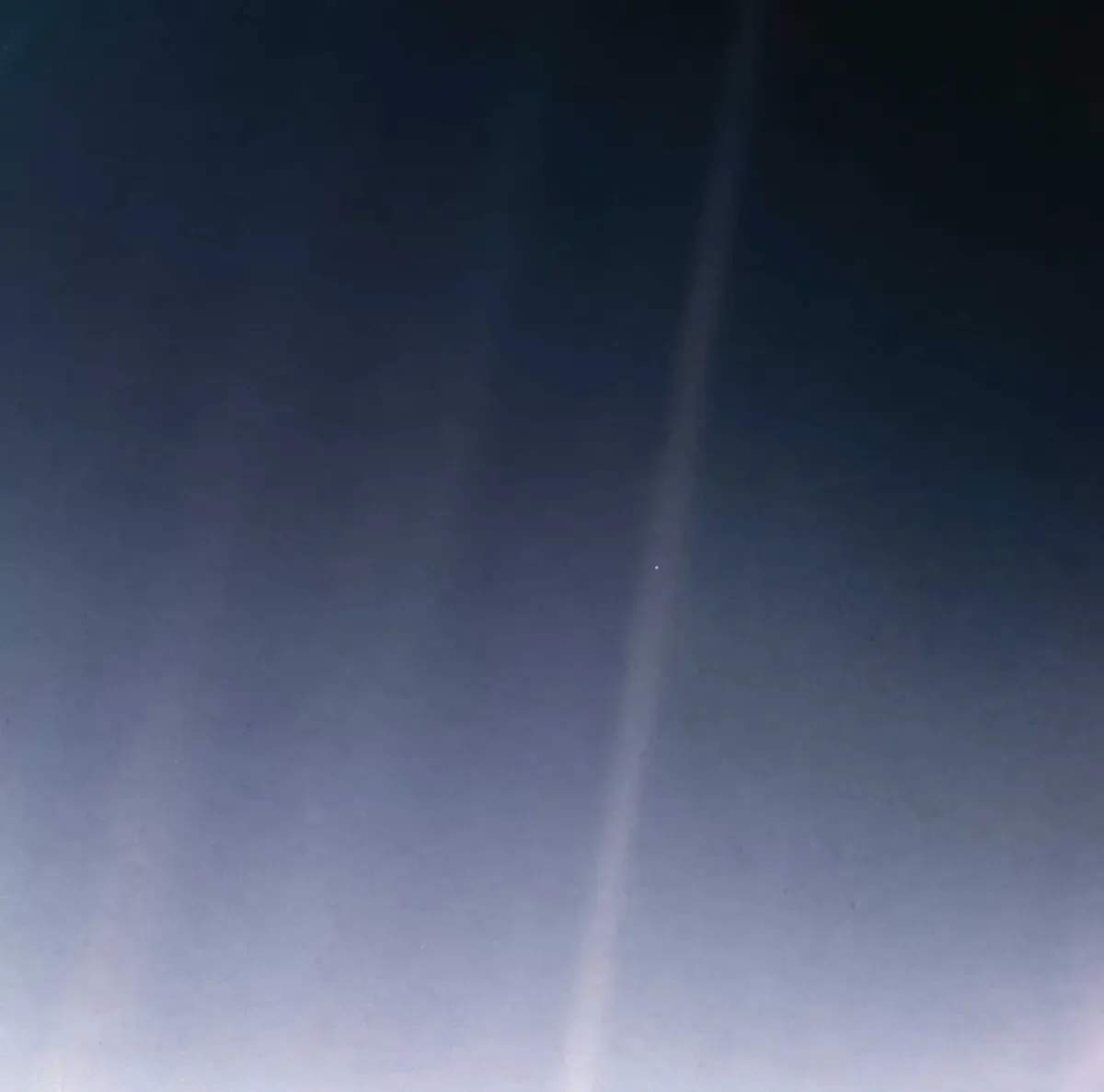
The first partial image of Earth taken from space was a grainy black-and-white photo from 1946. About twenty years later, the first color image was shot from a satellite, capturing the entire sphere in full-color against a black backdrop. We could see oceans, continents, and weather systems. Then, in 1990, NASA's Voyager 1 was nearly four billion miles from Earth. And at the request of astronomer Carl Sagan, the camera was turned around to snap a picture of Earth. In it, our planet is a barely perceptible pale blue dot against a backdrop of infinite darkness.
That photo has been referred to as the most humbling image ever taken.
I strongly recommend taking the three-minutes, forty-one seconds to watch Carl Sagen talk about the Pale Blue Dot image. His narration could easily signal you to put the book down and go for a walk. It’s pretty special.
In it, he challenges us to look at the world differently.
“The aggregate of our joy and suffering, thousands of confident religions, ideologies, and economic doctrines, every hunter and forager, every hero and coward, every creator and destroyer of civilization, every king and peasant, every young couple in love, every mother and father, hopeful child, inventor and explorer, every teacher of morals, every corrupt politician, every superstar, every supreme leader, every saint and sinner in the history of our species lived there — on a mote of dust, suspended in a sunbeam.”
As I listened to Sagan name a dozen things that have happened on our planet throughout history, I thought of all things he didn’t name. All of the moments within moments, within larger moments. 99.999% of everything that ever happens disappears. I even thought about the times I felt small, which now felt microscopic.
The simple truth is that most of us will not be remembered.
I don’t mean in a hundred years. I mean, like five. Take for example, the multitude of people you went to school with or worked alongside several years ago. Not only will the memory of you fade, people you talked to a hundred times will move on and possibly never think of you again.
Those closest to you might carry a version of you forward for a generation or two, and then your family photos and digital memories will be gone. The last of your stuff will be sold, donated, or thrown away. Slowly, then all of a sudden, it’ll be like you never existed. Even some of the most famous and influential figures who impacted generations will fade into obscurity.
This zoomed out perspective has been a great tool for me to fall back on. Because, like it or not, there’s a lot working against our ability to hold onto it.
The ego has a way of repeatedly thrusting focus onto ourselves. Our thoughts zoom in on our problems, dreams, relationships, careers, and countless small moments. This egocentric bias draws us into crafting stories that place us at the center. We’re the protagonist of everything, the main character in the movie that is our life. When things go well, it confirms the story we tell about ourselves. When they go poorly, it's probably evidence of some larger injustice. The story is always about us, and we’re almost always either the hero or the victim. Neither tends to be accurate.
Related to this is something called the Narrative Fallacy, which is our tendency over simplify those stories by ignoring inconvenient truths and turn grey areas into black and white facts about how the workld works.
There’s also the Spotlight Effect, something I’ve had countless conversations about over the years. It states that we dramatically overestimate how much other people notice us. Maybe we spilled something on our shirt ten minutes after showing up to a party. Or we tripped over our words during a presentation at work. We’re convinced everyone noticed, catalogued it, and is still thinking about it. They're not. They moved on in about four seconds. Because they're too busy worrying about their version of the same thing. The ego works overtime protecting us from the imaginary judgment of others. It’s that outer scorecard thing again.
Things like social media don’t help. Whether we’re actively doing this or not, many of us have taken rides on the curated self-promotion train. I’ve definitely been guilty of crafting highlight reels during personal shit-storms in an effort to save face or look good on the internet. Or think about all the young men who say things like, “I’m him” or that their “built different.”
Zoom out, none of us are that important. And most of what we’re doing isn’t serious. The unchecked ego can turn toxic quick.
Don’t get me wrong, the ego isn’t inherently bad.
It exists because it works. The ego is what separates us from the chaos of the world around us. It helps maintain internal continuity, connecting who we were last year to who we're trying to become. Without it, there's no agency, no accountability, no stable sense of self to build anything on.
The existence of or belief in ego isn’t itself problematic, letting it captain the ship is. The unchecked ego mistakes stories for reality. It makes passing statements feel personal. It measures our achievements against others. It repeatedly puts us at the center of attention, when we clearly are not.
It’s not even that that type of ego is “big” as popular wisdom says, more so that it’s hyperactive and noisy. Psychologist Heidi Wayment spent years studying what she called the "quiet ego." She theorized that the healthiest egos are flexible, non-defensive, and nurtured through “deliberate reflection.” Strong enough to hold us up, humble enough to acknowledge our place in the universe.
Zooming out helps us right-size our thoughts. In the grand scheme of things, we’re microscopic in both space and time. Most of what we do will disappear. It’s rarely all that important, and nobody actually cares. And while some might find it depressing, others see it as freeing.
Mapping our lives against infinity is a gift that signals us to stop playing it safe, to live a life that feels authentic. It helps us recognize when things like the Spotlight Effect or the Narrative Fallacy get ahold of us. Healthy egos are flexible, and able to balance agency and an accurate sense of self. They don’t feel the need to prove or defend themselves.
They see life as a microscopic, yet incredible, adventure.